
The October Crucible | October 30–November 1, 2026
The objective is simple: don’t move faster at the beginning. Move better for longer.
UTNP 9 Peaks is the final major physical challenge of my October Crucible. On October 3, I completed TransJeju 60K. On October 17, I ran the Gyeongju Marathon in 3:49:41 after attempting to break three hours. Now, less than two weeks later, I return to the Yeongnam Alps.
I have already proved that I can endure difficult conditions. This time, I want to use what I have learned: move efficiently, make better decisions, and preserve enough physical and mental capacity for the final mountains.
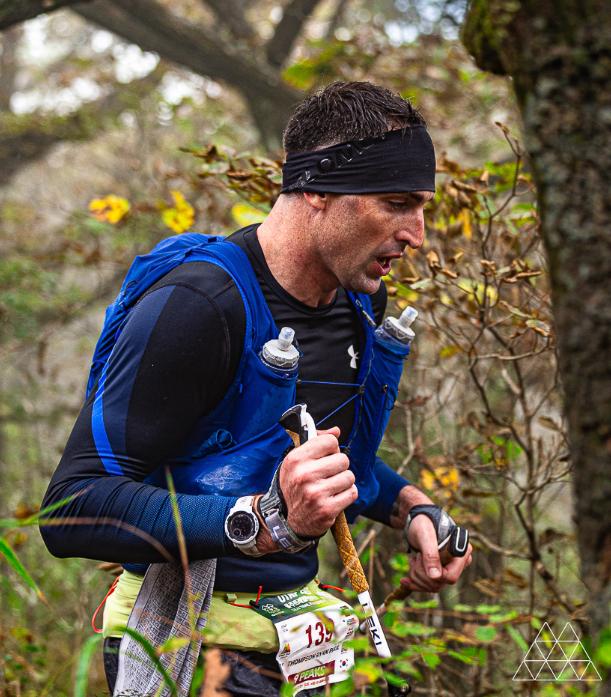
The Starting Line
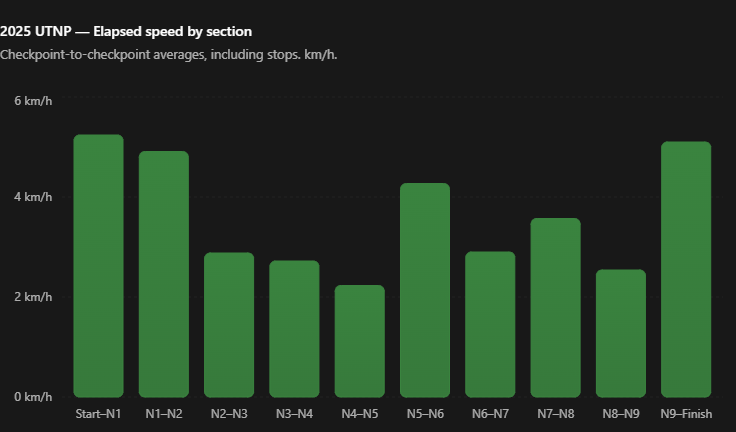
In 2025, I finished UTNP 9 Peaks in 37:29:20 over a reported 124.9 km. I had 2:30:40 remaining before the 40-hour limit. But the result does not tell the whole story.
Two windows stand out in my earlier checkpoint review: approximately km 33–64 and km 100–119. Near N8 Baenaecheon, I remember waiting around an hour for a friend. The final mountains became exceptionally difficult mentally.
Did that pause make restarting harder? Perhaps. It may also have provided useful rest. Fatigue, sleep deprivation, fueling and terrain were all part of the picture. My recollection cannot separate them. The lesson is to manage transitions deliberately, and to distinguish stopped time from slow movement.
ONEWAYGRIT / FIGURE 1
2025 checkpoint speeds
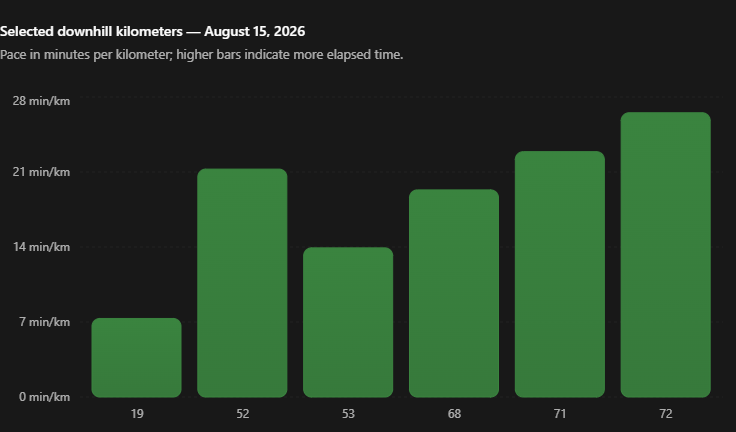
August 15, 2026 exposed another limitation. I covered 72.05 km in 19:37:43, with 5,702 m of recorded climbing, and did not finish. My recollection and earlier analysis point to much slower late descents. Terrain and conditions varied, so this cannot establish a single cause. But it gives me something specific to work on: preserve the ability to descend after hours of climbing.
ONEWAYGRIT / FIGURE 2
August 2026 downhill performance
Gyeongju added a different question. In photographs from the opening kilometers, my face looked tense. A photograph cannot tell me what caused the result, but it can remind me to check for effort that serves no purpose. Attentive without being rigid. Focused without forcing.
My starting condition matters too. Knee symptoms improved after the marathon, while hamstring tightness remained during early recovery. Comfortable walking is encouraging; it is not proof of full recovery. There is no meaningful fitness to gain now. Sleep, food, comfortable movement and preparation take priority.
Starting-line principle: accept my actual condition, not the condition I wish I had.
The Path
Six phases. One section at a time.
My working plan divides the race into six phases. Checkpoint names follow the earlier blueprint; exact distances, departure cutoffs and route details still need checking against the final official 2026 guide.
1. Start to A2 Daehyeon-ri — Establish rhythm. Hike sustained climbs, run naturally runnable ground and descend conservatively. Nothing to prove.
2. A2 to A4 Sangunsan — Settle into night. Check lighting, temperature and fueling before small problems grow. Calm is not slow.
3. A4 through Gajisan and Unmunsan to A5 Eoreumgol — Protect coordination. On technical or wet rocks, choose stable movement over urgency. Control is speed.
4. A5 through A6 Doraejae to A8 Cheolguso — Regain rhythm. Daylight may help visibility, but it does not erase fatigue. Momentum without urgency.
5. A8 through A10 Baenaecheon to A11 Dorajigogae — Assess honestly. Check climbing, descending and coordination. Assess. Adjust. Continue.
6. A11 through Ganwoljae to the finish — Stay purposeful. Avoid unnecessary prolonged stops, while taking rest when safety requires it. The race ends. The path continues.
Hike economically
At 197 cm, I naturally have a long stride. Steep ground does not require me to use it. I want shorter steps, a natural forward body position and a quiet upper body. On sustained steep climbs, hands just above my knees can help share the work.
ONEWAYGRIT / FIGURE 3
Efficient hiking technique
Relax jaw, shoulders and hands
Natural lean · hands on thighs when useful
Choose reachable footholds · keep breathing sustainable
Early effort should feel sustainable: roughly RPE 3–4, rising toward 4–5 on sustained steep climbs. These are personal guidelines, not fixed thresholds. If breathing becomes labored, shorten the steps or slow before the climb becomes a repeated cycle of surging and stopping.
Descend with control
The August lesson is not to become reckless. It is to stop spending my legs unnecessarily. Look several steps ahead, identify stable footholds and shorten the stride on steep or technical terrain. Avoid reaching far forward and braking hard on every step.
ONEWAYGRIT / FIGURE 4
Controlled descending technique
Scan ahead · let arms help balance
A slight bend that can change with the terrain
Avoid reaching far ahead · walk slippery rocks
For me, “responsive knees” means allowing some bend and movement, rather than locking my legs or holding a deep crouch. I will adapt to the ground, walk when needed and reduce speed when coordination deteriorates. Confidence can grow through controlled movement.
Fuel, reset, continue
Tailwind, GU gels and aid-station food are my working options. If tolerated, my carbohydrate target is approximately 60–75 grams per hour, counting everything. It is a plan to adapt to my stomach and conditions, not a number to force. Drink according to thirst and conditions, and account for sodium already in food and drinks.
At each checkpoint: replenish, assess and prepare. Before leaving, know what I have eaten, what water and clothing I carry, whether lighting and navigation are ready, and the next official departure cutoff.
After an ordinary stop, begin gently. Walk out comfortably and allow five to ten minutes to find rhythm. Avoid unnecessary prolonged sitting, but take sleep, medical attention or meaningful rest when needed.
At night, attention comes before speed. Keep lighting reliable, manage warmth and rain protection, and check alertness. Confusion, repeated stumbling, severe sleepiness, increasing localized pain or an altered gait are reasons to stop safely and seek help.
Observe. Adjust. Release.
I want to bring my Vipassana experience onto the trail in a practical way. Observe what is happening. Make the useful adjustment. Release the extra resistance I add to discomfort.
When tension rises, check the jaw, shoulders, hands and breathing. When frustration builds, return to the next section of trail. A good patch does not mean the difficult part is over. A bad patch does not mean the race is lost.
The Finish Line
A 35-hour finish would improve on 37:29:20 by 2:29:20. Removing the remembered hour of waiting produces a hypothetical 36:29:20, not an alternative official result. It assumes the rest of the race would have stayed exactly the same.
I will not use a target time as permission to push early. Actual conditions and official cutoffs come first. Success includes performance, execution and judgment: the result, how I moved and fueled, and whether I adapted honestly.
Afterward, I want to compare the checkpoint records and distinguish moving time, stopped time, terrain, weather and recollection. I want to understand what happened in the final mountains, rather than manufacture a lesson.
CLIMB: Short steps. Sustainable effort.
DESCEND: Controlled footing. Preserve coordination.
FUEL: Eat early. Eat consistently.
CHECKPOINT: Replenish. Assess. Restart.
MIND: Observe. Adjust. Release.
FINISH: One section at a time.
I have completed this race before. I cannot control every sensation or how my body will respond after 30 hours. I can control many of my decisions. Begin conservatively. Climb without unnecessary surges. Descend with care. Eat, assess and adapt.
The long cut is the shortcut.
Not the only path. Not the perfect path. Just a path worth walking.
Draft review notes: independently verify the supplied chart values against original checkpoint and lap records; verify the official 2026 start time, route figures, checkpoint OUT cutoffs, mandatory equipment and drop-bag location; update final recovery status. These items remain unresolved.

