
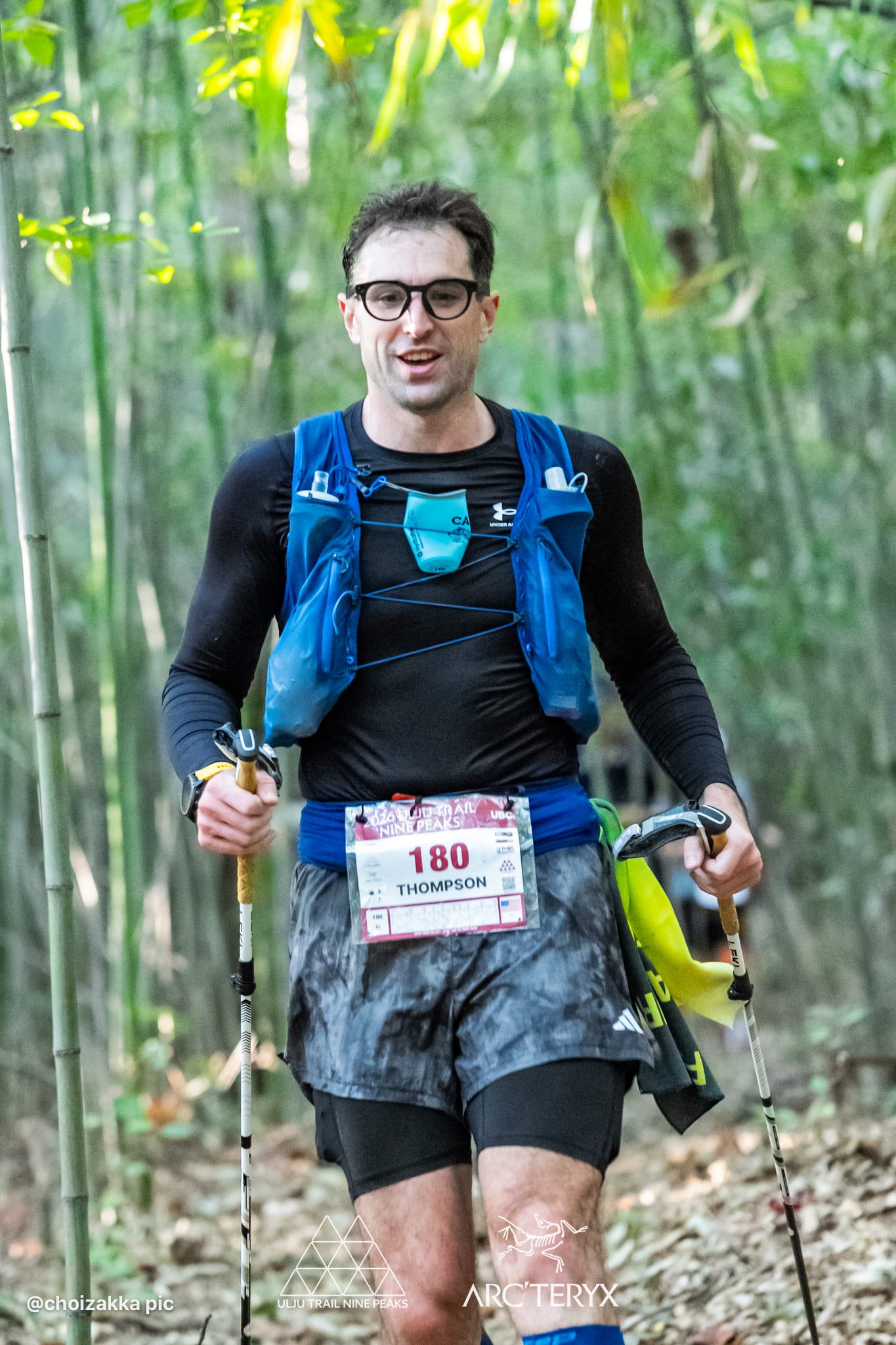
The October Crucible | Final Reflection
The Starting Line
In 2025, I completed UTNP 9 Peaks in approximately 37 hours and 29 minutes. Shortly afterward, I ran a half-marathon personal best of 1:29:50.
That gave me confidence.
If I could perform well after 122 kilometers in the mountains, perhaps I could pull another rabbit out of the hat in 2026.
The October Crucible was my attempt to find out.
Three races in four weeks.
TransJeju 60K. Gyeongju Marathon. UTNP 9 Peaks.
Two finishes. One DNF.
Was the challenge itself a mistake?
I’m still not convinced.
But looking back, I question whether I had properly prepared for it.
The Path
41.95 km. 3,202 m up. 3,173 m down. 11:42:44.
An IT band issue ended my race.
Seven years earlier, at TransJeju 2019, I experienced something similar. I continued for another 50 kilometers before eventually withdrawing.
That was my first DNF.
I learned a tremendous amount from that experience. Over the following years, I became a stronger, more experienced endurance athlete. In 2024, I returned to TransJeju and completed the 107K.
This time, I stopped earlier.
Perhaps that’s progress, too.
Too Many Goals, Not Enough Preparation
Over the previous nine months, I had pursued too many different athletic goals.
Road marathons. Trail ultras. Faster 10K times. Rowing.
I was training regularly, but not always with a clear priority.
Most importantly, I had neglected consistent strength training.
At 197 centimeters and approximately 102 kilograms, I’m not built like the typical elite mountain runner.
During a 1,000-meter descent, my body loses roughly one million joules of gravitational potential energy. Or at least that’s what ChatGPT tells me.
After descending 3,173 meters at UTNP, I have a pretty good idea of what that feels like.
My aerobic engine was reasonably well developed. But I hadn’t given enough attention to the muscular strength and durability needed to support it.
Would nine months of consistent strength training have prevented my IT band problem?
Maybe.
Maybe not.
The accumulated racing stress, recovery, terrain, and preparation all played potential roles.
I don’t know whether the October Crucible was beyond my limits.
What I do know is that I didn’t give myself the best opportunity to find out.
Turning My Size Into an Advantage
Look around the front of most trail races and you won’t see many athletes my size.
But there are always outliers.
You don’t see many 5-foot-5 players in the NBA either. Yet a few have competed at the highest level by developing exceptional skills and learning to use their strengths.
I want to take the same approach.
Rather than focusing on the disadvantages of being a larger runner, I’ll focus on developing the body I have.
That means consistent work on:
- Eccentric strength: Step-downs, split squats, and progressive downhill training.
- Hip and glute strength: Single-leg Romanian deadlifts, hip thrusts, and lateral band walks.
- Leg durability: Squats, calf raises, and controlled single-leg exercises.
- Stability and running economy: Better foot placement, balance, and downhill technique.
Not simply becoming stronger in the gym, but becoming a better mountain runner.
I can’t change my height. But I can change how effectively I use it.
The Finish Line
The cliché is that we learn more from our failures than our victories.
I’m beginning to think these experiences aren’t really failures at all.
My first DNF at TransJeju in 2019 forced me to reconsider how I trained. Five years later, I returned and finished the race.
Now UTNP 2026 has given me another opportunity to improve.
For 2027, the priority is clear.
UTNP 9 Peaks.
Fewer competing goals. More consistent strength training. Better downhill durability. Smarter recovery.
Running, rowing, and strength training will all serve that objective.
I still believe in attempting extraordinary challenges. But I want my preparation to match my ambition.
In 2025, I finished UTNP.
In 2026, I learned what I was missing.
In 2027, I’ll return with those lessons.
The long cut is the shortcut.
ONEWAYGRIT | 나한길

